
Intelligence is a common good.
Human and AI — together.
Free AI access infrastructure — locally owned, locally operated, in the languages people speak.

For most of human history, access to knowledge was a privilege.
Books were locked in monasteries. Universities served the elite. Legal advice, medical knowledge, financial guidance — these were luxuries that the wealthy could afford and the rest could not.
The internet changed access to information. But it did not change access to intelligence.
Today, a farmer in northern Namibia, a student in rural Indonesia, a mother in a Bolivian village — they can reach the internet. But they cannot easily access the tools that turn information into understanding, questions into answers, problems into solutions.
Those tools exist. They are called AI.
And right now, they mostly serve people who already have everything.
AI is the most powerful cognitive tool ever built.
It can explain complex medical conditions in plain language. It can help a first-generation student write a university application. It can tell a subsistence farmer which crops will survive a drought. It can translate a government document that determines whether a family keeps their home.
These are not hypothetical use cases. They are happening — but only for those with the right device, the right language, the right internet connection, the right credit card for a subscription.
Everyone else is locked out.
This is not a technical problem. The models exist. The infrastructure exists. The knowledge exists.
It is a distribution problem. And distribution problems are solvable.
Intelligence is a common good.
What we mean by intelligence here is not AI alone. It is what emerges when human knowledge and AI capacity meet — local experience, local language, local context, joined with the reasoning of a modern model. The communities this infrastructure serves are not just recipients of intelligence. They are part of what shapes what it becomes.
Like clean water, like education, like basic healthcare — access to cognitive tools should not depend on where you were born, what language you speak, or how much money you have.
We believe the gap between those who can access AI and those who cannot will become one of the defining inequalities of the 21st century. Not because AI is a luxury — but because it is becoming infrastructure.
When AI is infrastructure, being excluded from it means being excluded from opportunity itself.
And we believe this gap is closable. Not in decades. Now. With existing technology, modest infrastructure, and the right organizational will.
Bring existing AI where it's still out of reach — in the languages people speak, on the phone they already have.
The Common Intelligence Foundation builds and operates free AI access infrastructure for communities currently locked out of AI — wherever in the world that is.
We do not build new AI models. We bring existing ones where they have not reached yet — in the languages people speak, on the device they already have, for the questions that matter in everyday life.
-
01
Meet people where they are.
Not where we wish they were. A smartphone is not universal. A WhatsApp message is. A browser-based app requires onboarding. A phone number does not. We build for the infrastructure that already exists in the places where the service runs.
-
02
Sovereignty first.
Data generated by communities in Namibia should stay in Namibia. Data from Indonesia should stay in Indonesia. We do not extract. We do not sell. We do not profit from the people who use the service. Infrastructure we build is owned locally wherever possible.
-
03
Language is not a barrier.
The world does not speak English. Oshiwambo, Swahili, Tagalog, Quechua, Bengali — every language is a full human language deserving of full AI support. We invest in local language capability as a core infrastructure requirement, not an afterthought.
Ongiini — a proof of concept, running today.
Ongiini.ai is a free AI assistant for Namibia, accessible via WhatsApp, running in English and Afrikaans with Oshiwambo in development. Hosted on infrastructure we operate ourselves — currently in Germany during the pilot phase, with the goal of moving to Namibia once the service is sustainable. No US cloud provider sits in the pipeline.
A farmer asks about drought-resistant crops. A student asks for help understanding a contract. A mother asks about child nutrition. A first-time entrepreneur asks how to register a business.
These are the conversations that change lives — and that most people in Namibia have never been able to have with a knowledgeable, patient, always-available assistant.
Ongiini is small. It is local. It is a beginning. But the model it proves — free AI access, local infrastructure, local language, local ownership — is replicable anywhere in the world.
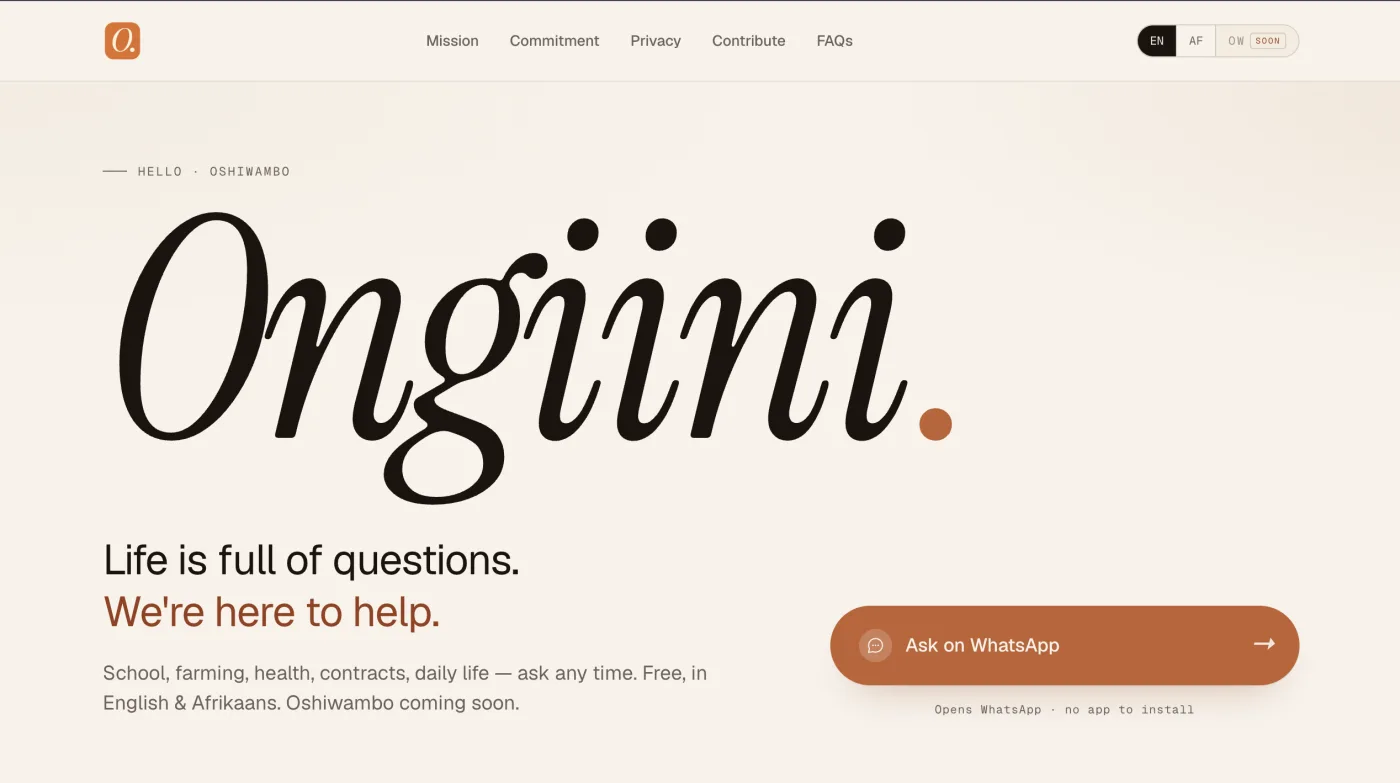 Visit ongiini.ai →
Every country deserves its own Ongiini.
Not a product built in San Francisco and deployed globally. A locally owned, locally operated, locally relevant AI service — built on open infrastructure, sustained by community support and philanthropic funding, accountable to the people who use it.
We envision a world where:
- A child in rural Malawi has the same access to a knowledgeable tutor as a child in Berlin.
- A smallholder farmer in Guatemala receives the same quality of agricultural advice as a large commercial operation.
- A first-generation university student in Nigeria gets the same quality of application support as a student whose parents went to Oxford.
- A patient in a remote Namibian village can ask about their symptoms in Oshiwambo and receive clear, evidence-based information before deciding whether to make a 100-kilometre journey to the nearest clinic.
This is not utopia. This is engineering. This is funding. This is will.
What it takes to make intelligence common.
Infrastructure.
Local compute in local datacenters. Not cloud services that extract data and revenue from the places where they operate. Physical hardware, locally owned, locally operated.
Language.
Investment in AI capabilities for underrepresented languages. Not as a nice-to-have — as a prerequisite for genuine access.
Funding.
We are a foundation. We do not sell. We do not monetise user data. We do not take venture capital. We are sustained by people and organisations who believe that intelligence should be a common good — and are willing to put resources behind that belief.
Partners.
Local organisations, universities, governments, and community leaders who understand their context better than we ever will. We build infrastructure. They know how to use it.
The window is open — but it will not stay open forever.
AI infrastructure is being built right now. Datacenters are going up. Models are being deployed. Distribution channels are being established.
If that infrastructure is built by a handful of commercial entities optimising for profit, the communities with the least purchasing power will be served last — or not at all.
If it is built now, deliberately, with equity as a design principle — the outcome can be different.
We have the technology. We have the models. We have proof that it works.
What we need is the decision that intelligence belongs to everyone.
If you believe intelligence is a common good — we'd like to hear from you.
Whether you have resources, skills, or connections that could help; whether you represent a community that deserves better access than it currently has; whether you simply want to know more — the door is open.